
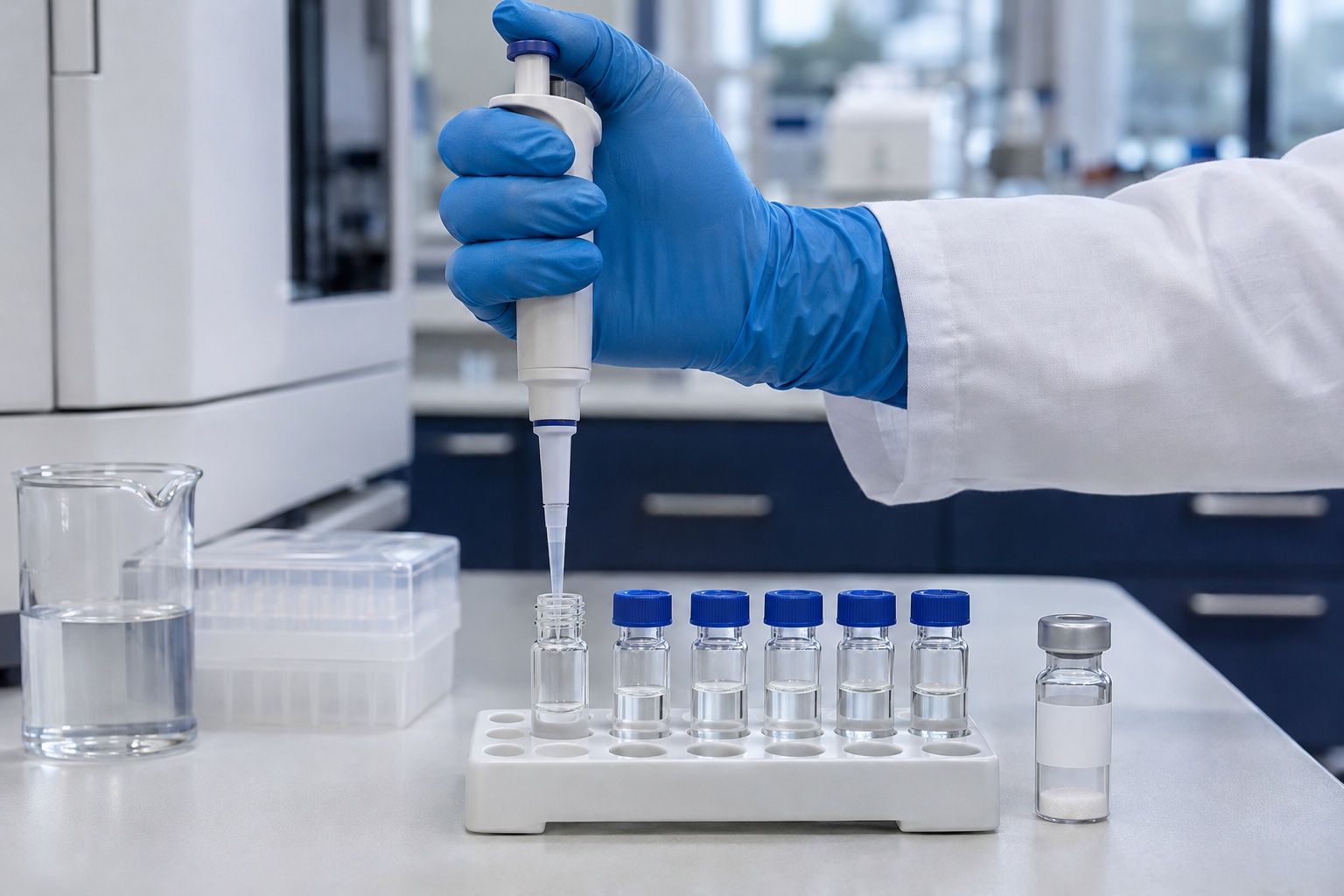
A product page may show a nominal vial format, while an analytical document reports a purity value. Those two pieces of information do not answer the same question. Keeping them separate makes a documentation enquiry more precise.
Purity describes the measured composition
In UV-detected HPLC, a purity result compares the target signal with other detected signals under the stated method. It is not, by itself, a direct measurement of the peptide mass inside a vial.
Content describes a different proportion
Net peptide content accounts for peptide material relative to non-peptidic components such as counterions and residual water. It should not be assumed to equal the chromatographic purity percentage.
Ask for the relevant information
When requesting documentation, explain which property your project needs to establish. Ask whether the available report contains the relevant test, rather than assuming that a headline purity value covers every requirement. Retain the report with its method, product reference and batch identifier.
Read the catalog format correctly
The LKZ catalog lists product specifications and prices for the stated packs. A format such as 5 mg is a catalog specification, not a new measurement produced by this website. Batch results, exact quotation details and available documents must be confirmed with LKZ.
This article is general documentation guidance for laboratory sourcing. It does not provide preparation instructions or medical-use advice.
Further reading
Bachem · Peptide analysis FAQ ↗
External references provide general background; they are not LKZ test results or an endorsement.
Find the relevant batch record.
Search the member library by product or batch reference.
Open COA library